How Isaac Eck Quit Being a Cop to Run 2 Airbnbs Across 2 States
Isaac Eck went from police officer to Airbnb entrepreneur, managing 2 properties across Alabama and Arkansas with his wife. Learn how they furnished a 5-bedroom for $18,000 and their strategy for winning over skeptical landlords.
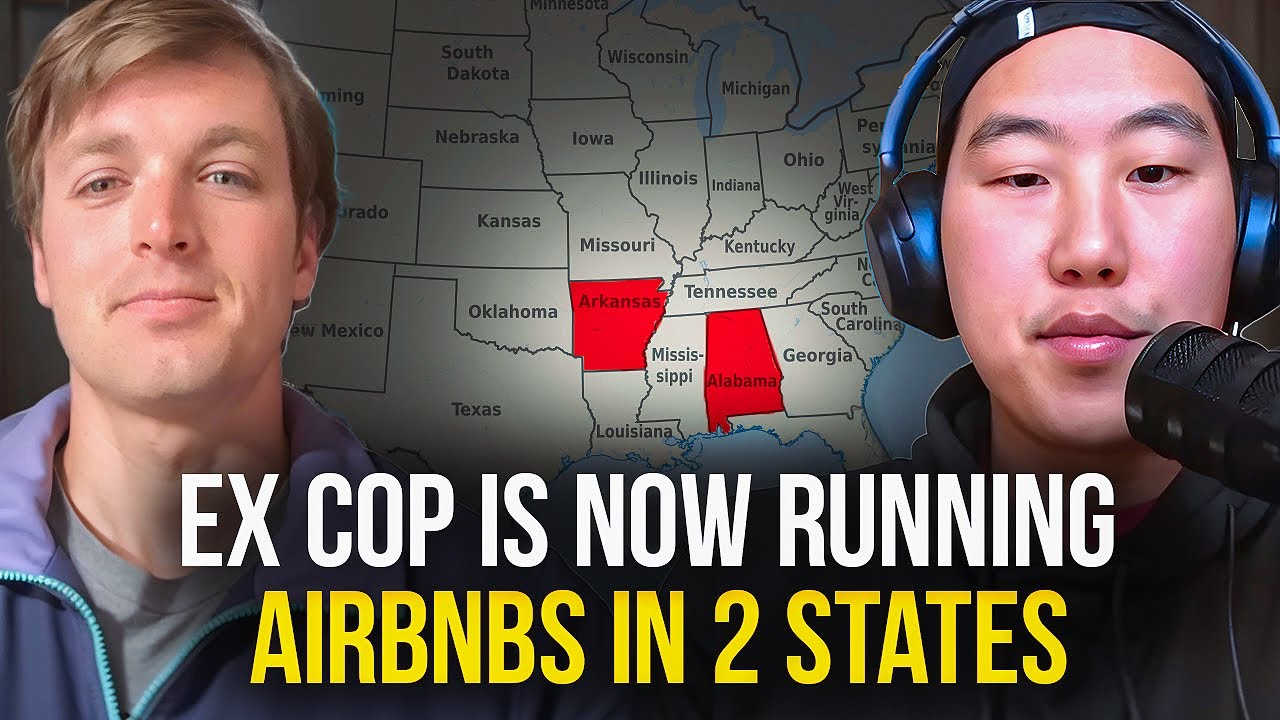
Isaac Eck went from police officer to Airbnb entrepreneur, quitting his job to run 2 properties across Alabama and Arkansas with his wife. Starting with a business management degree and an entrepreneurial spirit that began at age 13 with gumball machines, Isaac and his wife built an Airbnb arbitrage business that allows them to travel the country while she works as a travel nurse.
This case study breaks down exactly how Isaac found a landlord who already understood arbitrage, furnished a 5-bedroom property for $18,000, and navigates the challenges of running a seasonal lake property in Northwestern Arkansas. You'll learn his strategies for winning over skeptical landlords, finding rockstar cleaners through Turno, and automating operations with Price Labs and Hospitable.
In this article:
Quick Results: Isaac's Airbnb Arbitrage Numbers
| Metric | Value | Context |
|---|---|---|
| Properties | 2 | Birmingham, AL & Northwestern Arkansas |
| Birmingham Setup Cost | $18,000 | 5-bedroom, 3,000 sq ft |
| Facebook Marketplace Savings | $1,150+ | Sectional couch ($850 vs $2,000 retail) |
| Time from Course to Quit Job | 3 months | August to November |
| Revenue Goal | $140,000 | Annual combined target |
| Profit Goal | $60,000-$75,000 | Annual net profit target |
| Birmingham Status | Guest Favorite | Superhost expected April 1st |
| Guest Capacity | 12 people | Birmingham property |
Isaac's Background: From Cop to Airbnb Entrepreneur
You don't need to follow a traditional path to build an Airbnb business. Isaac's journey proves that entrepreneurial spirit and a willingness to take action matter more than a linear career in real estate.
Isaac grew up in Florida with a business management degree—but chose to become a police officer instead. The appeal wasn't the standard 9-to-5; it was the different schedule, the 12-hour shifts that theoretically gave more free time, and the chance to do something meaningful.
But the reality of shift work hit hard. Weekends weren't really free. Birthday parties got missed. The schedule controlled his life rather than the other way around.
"I just got tired of saying 'oh I work that weekend' or 'I can't go to this birthday party, I work that weekend.' So I knew I wanted to change and kind of reignited that entrepreneurial spirit I had since 13."
That entrepreneurial spirit wasn't new. At 13 years old, Isaac ran two gumball machines—one at a bowling alley, one at an office. He'd read Rich Dad Poor Dad and fallen in love with the concept of passive income. Tennis lessons during high school kept the hustle alive, but nothing felt like a real business until Airbnb arbitrage.
The catalyst came when Isaac got married. He and his wife shared something rare: identical goals about building wealth and hosting people. They didn't need to convince each other. They were already on the same page.
"This is something we both knew we wanted to get to. It wasn't really me convincing her—it was more us deciding to do it together."
Key Takeaway: Isaac's background as a cop taught him to have a "strong why" for difficult work. That same principle transferred directly to building a business: know your reason, and the hard days become manageable.
The Airbnb Arbitrage Journey: Isaac's Timeline
2023: Discovery and Decision
Situation: Married, working as a cop, watching YouTube videos about Airbnb arbitrage
Isaac discovered Preston's YouTube channel while researching ways to generate passive income. The free workshop laid out the facts and the process. By August, he and his wife had purchased the course.
The timing aligned perfectly with a major life change: his wife received an opportunity for travel nursing. This higher-paying, mobile nursing role would fund their startup costs while Isaac devoted himself fully to building the business.
November 2023: Quitting the Police Force
Situation: Three months into the program, ready to go full-time
Isaac quit his police job in November—just three months after joining Legacy Investing Show. This wasn't reckless; it was calculated. His wife's travel nursing income provided stability. His pension wasn't significant after only a couple years on the force. The opportunity cost of staying outweighed the risk of leaving.
"It has nothing to do with the profession—people always ask me that, like 'did you hate it?' I say no, I loved it. It's a very rewarding profession. But I was very early on into it, so as far as a pension goes, I didn't really lose much by leaving."
January 2024: First Property Live in Birmingham
Situation: First Airbnb property furnished and accepting guests
The Birmingham property went live around January 20th. It was a 5-bedroom house in a historic area that Isaac knew from his college years. He'd attended school there for a year and had friends and "people he considers family" in the area.
The property had a unique advantage: the previous tenant had already been doing Airbnb arbitrage. The landlord understood the model, had a decent experience, and only charged $100 extra per month for the short-term rental arrangement.
First Property Stats:
Bedrooms: 5 (listed as 4, but actually 5)
Square feet: 3,000
Guest capacity: 12
Furnishing cost: $18,000
First full month: February 2024
Early 2024: Second Property in Arkansas
Situation: Expanding to a seasonal lake market
Isaac's second property is on a lake in Northwestern Arkansas. It's a different beast entirely: highly seasonal, with slow winters and strong summers. February brought just one booking. But the June and July calendars already show profitable months locked in.
The hot tub wasn't working initially, which hurt bookings. Isaac is working with a local company to fix it—once operational, this amenity alone could significantly boost revenue in a market where pools and hot tubs drive premium rates.
How to Choose a Market for Airbnb Arbitrage: Isaac's Strategy
Birmingham works for Airbnb arbitrage because Isaac knew it personally. He analyzed multiple markets before choosing—including Okaloosa Beach, Florida (too expensive), Savannah (regulations), Scottsdale, Phoenix, and Grand Canyon areas—but kept coming back to familiarity.
The Market Research Process
Isaac's approach combined data analysis with local knowledge:
Step 1: Identify Attractions
He started by listing major attractions where travelers actually go. Beach destinations, historic cities, national parks—anywhere with built-in demand.
Step 2: Check Regulations
Many promising markets got eliminated immediately by regulations. This wasn't something Isaac anticipated going in, but it quickly became a major filter.
Step 3: Analyze Competition on AirDNA
For Birmingham specifically, Isaac discovered that 47% of listings were one-bedroom apartments. This saturation at the small end meant opportunity at the large end—only 4% of listings were 5+ bedrooms.
Step 4: Choose Comfort Over Sexiness
Birmingham isn't Miami or Austin. It's not the market everyone talks about. But Isaac knew the area, had connections for his boots-on-the-ground team, and understood what makes the city special.
The Unfair Advantage of Local Knowledge
When you know a market personally, your welcome book writes itself. Isaac can recommend restaurants that only locals know about. Guests feel like they're staying with someone who actually lives there.
"If you know that area, you know the places to eat. Your welcome book is all about the experience. If you have a detailed welcome book with restaurants that are only privy to Birmingham, guests feel like they're actually staying with a local."
Pro Tip: If you can't work in your own backyard, choose a market where you have existing relationships. Isaac's college friends became his boots-on-the-ground team. His buddy Josh handles handyman work and Ring camera issues. Trust is pre-built.
Airbnb Arbitrage Strategies That Actually Work: Isaac's Playbook
The difference between struggling and thriving in Airbnb arbitrage comes down to strategy. Isaac's success stems from three core approaches that leverage market gaps, landlord psychology, and competitive positioning.
Strategy 1: Target Underserved Property Sizes
What it is: Using AirDNA data to identify property sizes with low supply but high demand
Why it works: Most new hosts default to one-bedroom apartments because they're cheaper and easier. This creates saturation at the bottom and scarcity at the top. Isaac found that 47% of Birmingham listings were one-bedrooms, but only 4% were five-bedrooms.
Guests searching for large group accommodations filter by bedroom count. If you have a one-bedroom, you're competing with nearly half the market. If you have a five-bedroom, you're competing with 4%.
Isaac's Results with This Strategy:
Identified 5-bedroom gap in Birmingham market
Property can host 12 guests, capturing family reunions and group trips
Less competition for visibility in search results
"I knew very quickly that one-bedroom was not going to allow me to stand out. So I kind of went bigger, went home. I chose a five-bedroom—I saw that was 4% of the market."
Strategy 2: Win Over Landlords Who've Done Arbitrage Before
What it is: Specifically targeting properties where previous tenants did Airbnb arbitrage
Why it works: Most landlords have never heard of rental arbitrage. They need education, convincing, and reassurance. But landlords who've already experienced it? They just need someone reliable to take over.
Isaac's Birmingham property was listed as a 4-bedroom on Zillow. He called the landlord with his pitch ready—and got a surprising response.
"I called the landlord and I was like 'this looks great.' He goes 'oh yeah that sounds good.' I was like wait, what? I was expecting to answer all their questions. He's like 'oh so you want to Airbnb it?' I was like 'yeah.' He was like 'okay that sounds good, I do charge $100 more for that arrangement.'"
The previous tenant was leaving not because arbitrage failed, but because she wanted to transition from arbitrage to owning properties. Isaac contacted her directly through Airbnb, had a phone call, and confirmed the property performed well.
Isaac's Results with This Strategy:
Zero landlord convincing required
Only $100/month premium for STR arrangement
Previous tenant's AirDNA data served as baseline projections
Property was actually a 5-bedroom (listed as 4), which he discovered from the previous listing
Strategy 3: Amenity Competition Analysis
What it is: Studying top-performing competitors and strategically matching or exceeding their amenities
Why it works: Guests comparison shop. If a nearby property offers more amenities for a similar price, they'll book there instead. Isaac identified a 6-bedroom property two doors down doing $50,000 more in annual revenue—then studied exactly what they offered.
The competitor had arcade games, a speakeasy, and could sleep 16 people. Isaac couldn't match the bedroom count, but he could compete on amenities with strategic purchases.
Isaac's Results with This Strategy:
Added convertible pool/ping pong/dining table (multi-use space saver)
Created outdoor space with seating area as a differentiator
Positioned Birmingham property as a value alternative ($100/night less for similar amenities)
"Our kind of goal was—if there's 12 of them, why would they spend $100 more to go stay at that place with the same amenities when they could stay at ours?"
Isaac's Airbnb Arbitrage Results: The Numbers
Isaac's Birmingham property is performing well; his Arkansas property is a work in progress. Here's the honest breakdown of both properties' financials.
Birmingham Property Performance
February 2024 Results:
| Metric | February 2024 |
|---|---|
| Total Income | $4,823 |
| Total Expenses | $4,845 |
| Net Profit | -$22 (breakeven) |
Note: February included a plumbing issue that added unexpected expenses.
March 2024 Projections:
| Metric | March Projected |
|---|---|
| Confirmed Revenue | $1,800+ already |
| Open Weekends | 1 remaining |
| Projected Net | Positive |
Annual Projections:
Previous tenant's revenue (baseline): $74,000
Isaac's target with improved amenities: $80,000-$85,000
Neighbor's 6-bedroom revenue (ceiling): $125,000
Arkansas Property Performance
The Arkansas lake property is highly seasonal. Here's the reality:
February 2024: 1 booking total (snow everywhere, off-season)
March 2024: 3 bookings, close to break-even with 2 open weekends remaining
June-July 2024: Already profitable months with confirmed bookings
Challenges Being Addressed:
Hot tub not working (being fixed)
Photos need to be retaken (not thrilled with photographer's work)
Living room needs more color to pop in listing photos
Market Context:
Similar properties in the area range from $62,000 to $110,000 in annual revenue—a $48,000 swing. Isaac is targeting $55,000-$62,000 in year one, which would cover expenses and provide modest profit.
"Even if we come in below $62K, let's say $55K, we're still in the green. Maybe not making our money back on initial investment, but at least the expenses to operate aren't losing money."
Combined Portfolio Goals
| Goal | Target |
|---|---|
| Combined Annual Revenue | $140,000 |
| Combined Annual Net Profit | $60,000-$75,000 |
| New Properties This Year | 1 additional arbitrage |
| Next Year Goal | Purchase first owned property |
Airbnb Arbitrage Lessons: What Isaac Learned the Hard Way
These five lessons transformed Isaac from someone watching YouTube videos to someone running two properties across two states. Each one came from real experience—and could save you months of trial and error.
"Being a cop, they always tell you to have a strong why that you do something. I would say the same thing applies to business."
Lesson 1: Take Action Before You Feel Ready
The Mistake: Waiting until you know everything before making your first call
What Happened: Before joining the course, Isaac would message landlords on Zillow with vague pitches like "hey, I have a proposition for you"—without even knowing if the property would be profitable. He cringes at his old messages now, but those early attempts taught him something crucial: action beats perfection.
His first real calls after joining the program weren't polished either. He got yeses that fell apart when he dug into regulations or ran the numbers. But each conversation improved his skills.
Why This Matters: The only way to get better at landlord conversations is to have landlord conversations. Watching videos about it isn't the same thing.
"I got a lot of yeses, but that was before my process would kind of hone down. I would get yeses and I would just kind of—analysis by paralysis—I didn't want to mess up."
Lesson 2: Communication Is Everything for Cleaners
The Mistake: Hiring based on price or availability instead of responsiveness
What Happened: Isaac uses Turno to find cleaners. Multiple cleaners bid on each job, but not all are created equal. His filter: if someone bids on a job but doesn't respond quickly when he reaches out for an interview, they're automatically disqualified.
Why This Matters: In the Airbnb business, problems happen at inconvenient times. A guest reports an issue at 10pm. A cleaner needs to know about a same-day turnover. If your cleaner takes days to respond to normal messages, imagine how they'll handle emergencies.
"If you bid on a job and you don't respond to me when I'm asking you for a phone interview—I'm not going to waste my time interviewing you, because you didn't respond to a job that you bid on."
Lesson 3: Have a Strong Why
The Mistake: Starting a business because it sounds good, not because you have a deep reason
What Happened: Isaac's police training emphasized having a "strong why" for the job. Cops walk into unpleasant situations regularly; without purpose, the weight breaks you. He applied the same principle to entrepreneurship.
His why: freedom to be present. He and his wife want flexibility—not just wealth, but time. The ability to be at important events, to travel together while she does travel nursing, to not ask permission for time off.
Why This Matters: Building an Airbnb business involves hundreds of calls, unexpected problems, and months before meaningful profit. Surface-level motivation evaporates. Deep motivation sustains.
"If you want to be financially free, ask yourself why. If the reason is to spend more time with your wife and kids, then ask yourself why. Follow the why until you really get down to the deep meaning of what your motivation is."
Lesson 4: Leverage Your Partner's Strengths
The Mistake: Trying to do everything yourself when you have a capable partner
What Happened: Isaac is self-aware about his limitations. He's not a design person—he jokes that he can barely match his own clothes. But his wife has a natural eye for aesthetics, colors, and space.
Their division of labor: she designs, he executes. She buys, he builds. She handles the creative vision; he handles the operational logistics.
Why This Matters: Airbnb arbitrage requires both creative skills (design, photography, guest experience) and operational skills (landlord negotiation, team management, financial tracking). Rarely does one person excel at both.
"We always joke that she buys it and I build it. We work together to come up with color schemes and things. She did a great job—she loves doing that, she has a pretty good eye for it."
Lesson 5: Anticipate Seasonality (and Budget for It)
The Mistake: Assuming monthly income will be consistent across all seasons
What Happened: Isaac's Arkansas property is on a lake. That means strong summers and weak winters. February had one booking. This wasn't a surprise—but it still required coming out of pocket to cover expenses.
The key is anticipating this in your projections. If you know January-February will be slow, budget startup capital accordingly. Don't expect to be cash-flow positive every month in a seasonal market.
Why This Matters: Seasonal markets can still be profitable on an annual basis, but they require cash reserves for slow months. Beginners who don't plan for this get blindsided.
"Last month we had to feed the business a little bit more than we anticipated. All in all, we've had a great time doing it. But you have to anticipate the seasonality."
Best Tools for Airbnb Arbitrage: Isaac's Tech Stack
Isaac manages 2 properties across 2 states using automation tools that handle routine tasks automatically. Here's his complete tech stack.
Essential Tools Overview
| Category | Tool | Purpose | Why Isaac Chose It |
|---|---|---|---|
| Dynamic Pricing | Price Labs | Automatic rate adjustments | Set-it-and-forget-it pricing optimization |
| Guest Communication | Hospitable | Automated messaging & lock codes | Handles routine guest communication |
| Cleaner Management | Turno | Finding and coordinating cleaners | Cleaners bid on jobs, easy comparison |
| Market Research | AirDNA | Competition analysis & projections | Data-driven market selection |
Price Labs: Set-It-and-Forget-It Pricing
What it does: Automatically adjusts nightly rates based on demand, seasonality, local events, and competitor pricing
How Isaac uses it: Isaac connects his listings to Price Labs and lets it handle daily pricing decisions. During slow periods, rates automatically drop to attract bookings. During high-demand events, rates increase to capture premium revenue.
Pro tip: Set minimum rates you're comfortable with—don't let automation price you below profitability during slow seasons.
Hospitable: Automation Central
What it does: Automates guest messaging, sends check-in instructions, generates smart lock codes, and handles routine communication
How Isaac uses it: Every booking triggers automatic messages: confirmation, check-in details with lock codes, checkout reminders. Isaac only intervenes for special requests or unusual situations.
"Early on I would get a booking and I'm scrambling to respond within five minutes. Now I get to just look at my phone—oh we got a booking, great—and I don't have to scram and type out a text message."
Pro tip: Include personal touches in automated messages. Make templates feel human even though they're automatic.
Turno: Cleaner Marketplace
What it does: Connects hosts with local cleaners who bid on turnover jobs
How Isaac uses it: He posts cleaning jobs and receives multiple bids. His vetting process focuses on response speed and communication during the interview process—not just price.
Pro tip: Don't automatically choose the cheapest bid. A reliable $150 cleaner beats an unreliable $100 cleaner every time.
AirDNA: Market Intelligence
What it does: Compiles short-term rental data including revenue, occupancy, and competitive analysis
How Isaac uses it: Before selecting Birmingham, Isaac analyzed the market composition—finding that 47% of listings were one-bedrooms. He also found his first property's previous listing on AirDNA, giving him baseline revenue projections.
Pro tip: Cross-reference Zillow listings with AirDNA to find properties where previous tenants did arbitrage.
Isaac's Advice for Airbnb Arbitrage Beginners
"Have a strong reason for why you're doing it. Not just 'I want to be rich'—follow the why until you get down to the deep meaning of what your motivation is."
If Isaac were starting over today, here's exactly what he would do:
Step 1: Getting Started (Week 1-2)
Start with your why. Write it down. Keep asking "why?" until you hit something that matters emotionally, not just financially. This becomes your anchor when things get hard.
Choose a market where you have connections—friends, family, former colleagues. The unfair advantage of knowing an area personally shortens your learning curve dramatically. If you can't be in your own city, pick somewhere you've lived or visited extensively.
Set a timeline. Isaac's wife's support gave him freedom to quit his job, but even with support, deadlines create accountability. "Someday" never comes.
Step 2: Finding Properties (Week 3-6)
Use AirDNA to analyze your market's listing composition. Find the gaps—property sizes or types that are underrepresented. That's where competition is lowest.
Call landlords before you feel ready. Track every conversation in a spreadsheet. Your first calls will be rough; your twentieth will be smooth. The only way to improve is practice.
Look for landlords who've done arbitrage before. They require zero education—just proof you're reliable.
Step 3: Setting Up Your First Property (Week 7-10)
Budget $15,000-$20,000 for furnishing a 3-5 bedroom property. Use Facebook Marketplace for big-ticket items like couches. Isaac saved over $1,000 on a sectional alone.
Study your top competitors' amenities. Add 1-2 items that differentiate your property or justify your pricing. Isaac added a convertible pool/ping pong table to compete with a more expensive neighbor.
Find your cleaner through Turno. Interview multiple candidates. Prioritize communication speed over price—responsive cleaners are reliable cleaners.
Step 4: Building Systems (Month 3+)
Automate everything possible with Price Labs and Hospitable. Your time should go toward strategic decisions, not typing the same check-in message for every guest.
Get to Guest Favorite status, then Superhost. These badges improve visibility in search results and build guest trust.
Consider your next property while the first one stabilizes. Isaac plans to add one more arbitrage property this year, then transition to purchasing next year.
Mindset Advice from Isaac
The 12-hour shifts as a cop taught Isaac something valuable: schedule flexibility sounds great on paper but often means less control, not more. Real freedom comes from building something you own.
His wife being fully aligned made the journey sustainable. They celebrate wins together, troubleshoot problems together, and share the same vision. If your partner isn't on board, get them on board first—or this will feel like a solo battle with a skeptic at home.
"We both have a passion for real estate and we both have a passion for hosting people. We thought Airbnb would be a really cool combination of the two."
Watch Isaac's Full Interview
Video highlights:
0:00 - Introduction and Isaac's background
5:30 - The decision to quit being a cop
10:00 - Market research and choosing Birmingham
15:30 - Finding the landlord who already understood arbitrage
22:00 - Furnishing on a budget with Facebook Marketplace
28:00 - Managing the seasonal Arkansas property
32:00 - Tools, automation, and future goals
Frequently Asked Questions
Can you really start Airbnb arbitrage as a couple?
Yes—and it can be a major advantage. Isaac and his wife divide responsibilities based on strengths: she handles design and decor decisions, he handles landlord outreach and operations. Their joke captures it perfectly: "she buys it and I build it."
The key is alignment on goals. Isaac didn't have to convince his wife—they both wanted the same thing from the start. If your partner is skeptical, address that first. Running a business with someone who doubts the model creates friction.
Travel nursing allowed Isaac's wife to provide financial stability while he focused full-time on building the business. Having one partner with stable income reduces the pressure on early arbitrage returns.
How do you handle a property that's underperforming?
Isaac's Arkansas property is currently underperforming projections. His approach:
If after a full year the numbers still don't work, arbitrage offers an exit: furniture moves to your next property, and you're out of the lease without losing real estate equity.
What if I don't have connections in any good markets?
Isaac recommends starting where you have relationships, but it's not strictly required. His process for building a boots-on-the-ground team:
The cleaner is your eyes on the ground. If you find someone responsive and reliable, they become your connection to the local market.
Start Your Airbnb Arbitrage Journey
Ready to build an Airbnb arbitrage business that gives you location freedom?
Isaac proved that with the right partner, a willingness to take action, and strategic market selection, you can build a portfolio across multiple states—all while traveling the country.
Learn more about Legacy Investing Show →
Related Success Stories
Helpful Resources
About Legacy Investing Show
Legacy Investing Show is Preston Seo's comprehensive Airbnb arbitrage training program. Since its founding, the program has:
Trained 2,000+ students across the United States
Generated $10M+ in cumulative student revenue
Helped students launch properties in 90 days or less
Built a community of active investors sharing wins and learnings
Preston Seo has personally built a $15 million real estate portfolio generating over $400,000 per year in net profit from short-term rentals. He created Legacy Investing Show to teach the exact systems that scaled his business.
blog resources | Watch free training →
This case study is based on Isaac Eck's video interview conducted in March 2024. All statistics and quotes are directly from Isaac's experience. Individual results vary based on market, effort, and capital invested.
Last updated: February 16, 2026
Preston Seo
Real estate investor and financial educator helping people build generational wealth through smart investing strategies.
Sources to check before you act
Check primary guidance and your own records before you treat any page as a final answer.
- Current IRS forms, instructions, and publications for the relevant tax year
- Your actual account statements, payroll reports, entity records, and advisor memos
Educational only. Results vary. Tax, legal, and investment decisions should be reviewed with a qualified professional who can see your full situation.
Frequently asked questions
Can you start Airbnb arbitrage as a couple?
Yes. Isaac and his wife run their Airbnb business as a team. She handles design and decor while he focuses on landlord outreach and operations. They joke that 'she buys it and I build it.' Having a partner who shares the same goals makes the journey more sustainable.
How much does it cost to furnish a 5-bedroom Airbnb?
Isaac furnished his 5-bedroom, 3,000 sq ft property in Birmingham for approximately $18,000. They saved money by finding a sectional couch on Facebook Marketplace for $850 (retail value $2,000+) and shopping strategically at IKEA for accent pieces.
What if the landlord already had a bad experience with Airbnb?
Isaac found a property where the previous tenant was doing arbitrage and leaving. He contacted the former host on Airbnb, learned there were no problems with the property (she just wanted to transition to owning), and used her revenue data from AirDNA as his baseline projections.
Is Airbnb arbitrage profitable in seasonal markets?
It can be, but requires planning. Isaac's Arkansas lake property is highly seasonal with slow winter months (one booking in February) but strong summer performance. He anticipated coming out of pocket during slow months and already has profitable June/July bookings locked in.
How do you find a cleaner for your Airbnb property?
Isaac uses Turno, a platform where cleaners bid on jobs. He interviews candidates by phone, prioritizing fast communicators. His top cleaner responds to messages almost immediately—slow responders are automatic disqualifications. Communication speed predicts reliability.
Can you quit your job to do Airbnb arbitrage?
Isaac quit his police job in November after joining the program in August. His wife's travel nursing income provided financial stability during the transition. He recommends having a financial cushion or secondary income before quitting your 9-to-5.
What tools automate Airbnb property management?
Isaac uses Price Labs for dynamic pricing and Hospitable for automated guest messaging and smart lock code generation. These tools handle routine tasks so he only needs to manage cleaner coordination and special guest requests.
How do you stand out in a competitive Airbnb market?
Isaac analyzed Birmingham on AirDNA and found 47% of listings were one-bedrooms. He chose a 5-bedroom property (only 4% of market) to target large groups. He also added amenities like a convertible pool/ping pong table to compete with nearby 6-bedroom properties charging more.